
Transmission Ratio, rolling circumference and lead

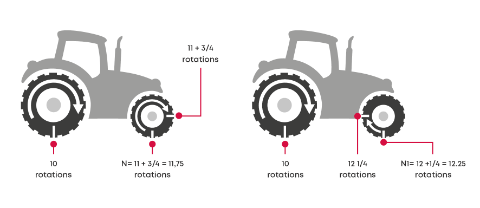
Determining the transmission ratio
To make optimal use of four-wheel drive, the rolling circumference of the front tires must be smaller than that of the rear tires—this is known as lead. Tractor manufacturers usually specify standard tire sizes, and often multiple size combinations are possible for a specific tractor model, as long as they fall within the correct lead range.
For optimal four-wheel drive performance, the lead value typically ranges between +1% and +5% (rolling circumference front tires > rolling circumference rear tires). The acceptable range is generally between 0% and +6%.
A lead value below 0% or above +6% can negatively affect driving performance and steering behavior (especially in turns), and may result in excessive wear on both front and rear tires, as well as premature wear of the transmission.
The ratio between the number of revolutions of the front and rear axles in a mechanical four-wheel drive system is fixed. This ratio is determined by the gearbox and is referred to as the transmission ratio. Depending on the tractor brand and model, this value typically ranges between 1.20 and 1.50.
The exact mechanical transmission ratio can always be found in the tractor’s manual or technical documentation.
|
|
Calculating lead
If you know the rolling circumference of the front and rear tires and the tractor’s transmission ratio, you can calculate the lead using the following formula:
|
|
rolling circumference front tyre
|
|
|
% inter-axle ratio |
----------------------------------------- |
-1 |
*100% |
|
|
rolling circumference rear tyre |
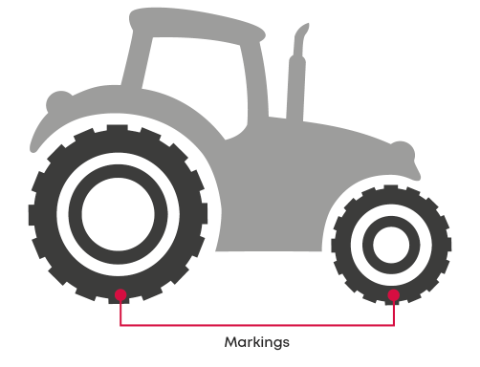
Dynamic measurement of the transmission ratio
- Engage four-wheel drive and differential lock
- Mark both front and rear tires at the bottom or contact patch
- Rotate the rear tire 10 times forward
- Count the number of revolutions of the front tire
- Calculation: divide the front tire revolutions by 10
Example:
13.5 / 10 = 1.35 → transmission ratio
The exact mechanical transmission ratio for most tractors can be found in the manual. Need personal advice from our experts? We are always here to help.
Different tire widths on the same rim: converting inches to millimeters
In some situations, you may want to fit tires with a different width on the same rim. This is possible, but converting tire sizes from inches to millimeters can be complex.
1 inch = 25.4 mm
This allows you to convert inch-based tire sizes into millimeters. Note that this is usually an approximation rather than an exact value.
Example:
A 12.4R20 tire is 12.4 inches wide, which equals approximately 315 mm.
The corresponding metric tire size is 320/85R20:
- 320 = tire width in mm
- 85 = aspect ratio
- R = radial construction
- 20 = rim diameter in inches
The rim diameter must, of course, remain the same.
For more background on tire sizes and applications, see the article:
“Conversion options from standard tires to narrow tires.”
Different tire widths on the same rim: converting inches to millimeters
In some situations, you may want to fit tires with a different width on the same rim. This is possible, but converting tire sizes from inches to millimeters can be complex.
1 inch = 25.4 mm
This allows you to convert inch-based tire sizes into millimeters. Note that this is usually an approximation rather than an exact value.
Example:
A 12.4R20 tire is 12.4 inches wide, which equals approximately 315 mm.
The corresponding metric tire size is 320/85R20:
- 320 = tire width in mm
- 85 = aspect ratio
- R = radial construction
- 20 = rim diameter in inches
The rim diameter must, of course, remain the same.
For more background on tire sizes and applications, see the article:
“Conversion options from standard tires to narrow tires.”