
Preventing soil compaction with agricultural tyres

What is soil compaction?
Soil compaction occurs when the soil is repeatedly driven over by heavy machinery. The soil becomes compressed, leading to several negative effects:
- disrupted water management
- reduced oxygen and space for root development
- rutting, especially in wet conditions during spring
- the need for soil recovery through ploughing or cultivation → extra time and fuel costs
Important: narrow tyres tend to sink more easily in wet conditions. In such cases, wider tyres with more volume and greater track width are recommended.
Conclusion: soil compaction reduces soil quality and requires additional recovery work, increasing costs.
Wider agricultural tyres: more contact, less pressure
Narrow tyres are more likely to sink in wet conditions. Therefore, wider tyres with higher air volume and greater footprint are often preferred.
Wider agricultural tyres distribute the machine weight over a larger contact area, reducing ground pressure. This results in clear benefits:
- less rutting and soil deformation
- improved traction and reduced slip
- lower fuel consumption due to more efficient power transfer
Example: replacing a 520/85R38 tyre with a wider 650/65R38 tyre can significantly reduce ground pressure.
See also:
Conversion options: from standard tyres to wide tyres
Conclusion: wider tyres improve load distribution and reduce soil damage.
How agricultural tyres help prevent soil compaction
Tyre pressure and ground pressure
Lower tyre pressure increases the contact area, which reduces ground pressure and limits rutting.
Contact area + air volume = lower slip + less soil damage
See also:
Slip percentage of agricultural tyres
Speed and load: with or without a central tyre inflation system
- Without a central tyre inflation system (CTIS): always determine maximum speed and load first to select the correct pressure
- With CTIS: low pressure in the field and higher pressure on the road → less soil compaction, reduced wear and fuel savings
Conclusion: optimising tyre pressure based on conditions is key to reducing soil compaction.
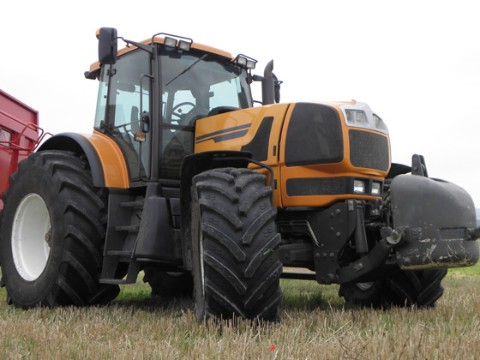
Lower tyre pressure with the same load
In addition to standard tyres, there are also several tyre types available that allow you to use a lower tyre pressure while carrying the same load. We have listed them for you and explain the differences, so you can choose the best tyres for your situation. IF and VF tyres are becoming increasingly popular, and users value their efficiency, for example when preparing the land or spreading fertiliser.
What are IF tyres?
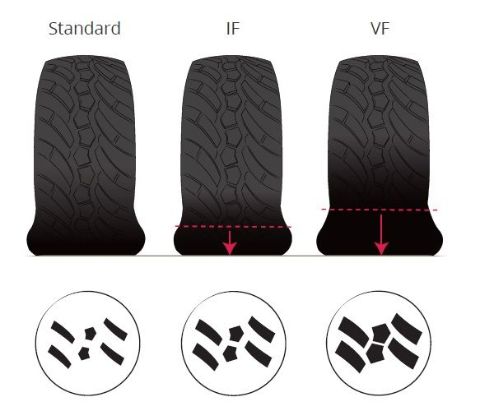
IF (Improved Flexion) tyres allow operation at the same load as standard tyres, but with 20% lower tyre pressure. This helps reduce soil compaction.
A major advantage is that tyre pressure is independent of speed. Unlike standard tyres, pressure does not need to be adjusted when speed increases.
Conclusion: IF tyres improve soil protection without compromising load capacity.
What are VF tyres?
If more than 20% pressure reduction is required, VF (Very High Flexion) tyres are the next step.
These tyres can operate at the same load with up to 40% lower pressure, further reducing soil compaction. Like IF tyres, VF tyre pressure is largely speed-independent.
However, for prolonged road transport, slightly higher pressure is recommended.
Conclusion: VF tyres offer maximum reduction in ground pressure and improved efficiency.
What is the difference between IF and VF tyres?
- IF tyres: 20% lower pressure at the same load or increased load at the same pressure
- VF tyres: 40% lower pressure at the same load or significantly higher load capacity
Both types maintain pressure independent of speed, although adjustments may be needed for extended transport use.
Conclusion: VF tyres go further than IF tyres in reducing soil compaction.
Cyclic Field Operation / Cyclic Harvesting Operation (CFO/CHO)
CFO/CHO tyres are often used on harvesting machines such as combines or beet harvesters. These machines operate at low speeds with high peak loads and strongly fluctuating loads.
Example:
A beet harvester drives empty to the field, begins harvesting, gradually fills the bunker, then unloads and repeats the cycle.
CFO/CHO tyres are specifically designed for these load cycles.
Conclusion: CFO/CHO tyres are ideal for machines with fluctuating loads and cyclic operations.
Summary
- IF technology (Improved Flexion):
up to 20% lower tyre pressure at the same load or up to 20% higher load capacity - VF technology (Very High Flexion):
up to 40% lower tyre pressure at the same load or up to 40% higher load capacity - CFO/CHO technology:
ideal for machines with strongly varying loads
By selecting the right agricultural tyres and optimising tyre pressure, you can prevent soil compaction, improve soil quality and increase yield.
Conclusion: correct tyre technology and pressure management are essential for protecting soil and maximising productivity.
